

8 Powerful Life-Changing Lessons from the Life of Lord Shiva

In every universe, there are 3 Gods who administer it. Bhagwan Brahma is known as the creator of the universe, Bhagwan Narayan is known as the preserver of the universe, and Bhagwan Shiva is known as the destroyer of the universe.
In this whole universe, anything that is created has to be destroyed, and that destruction ics done by Bhagwan Shiva.
Now, let us explore the eight wonderful qualities revealed through Bhagwan Shiva, which stand not only as divine attributes but also as profound life lessons for humanity.
1. Awakening the Third Eye: Conquering Distractions with Knowledge

One of the most famous stories from Shiva’s life involves the burning of Kamadeva, the god of desire.
A demon named Andhak had received a boon that only Shiva’s son could kill him. At that time, Shiva was unmarried and immersed in deep meditation. To awaken him from penance so that he could marry Parvati and produce a son, Indra sent Kamadeva to disturb him.
Despite the presence of celestial apsaras and Parvati’s intense devotion, Shiva remained unmoved. But when Kamadeva shot his arrow of desire, Shiva opened his third eye and reduced him to ashes.
💡 Life Lesson
In our own lives, distractions constantly try to disturb our focus—social media, temptations, doubts, and negative influences.
The third eye represents inner wisdom—the power to distinguish right from wrong. When we awaken this inner awareness through knowledge and guidance from a true guru, distractions lose their power.
True strength lies not in suppressing desire, but in mastering it.
2. Drinking the Poison: Taking Responsibility in Difficult Times

During the great cosmic event known as the Samudra Manthan (Churning of the Ocean), a deadly poison called Halahal emerged first. It was so dangerous that it threatened to destroy the entire universe.
None of the gods or demons were willing to take responsibility. Finally, they turned to Shiva.
Without hesitation, Shiva drank the poison to save the world. Parvati, worried for him, stopped it at his throat, turning it blue. That is why he is called Neelkanth—the blue-throated one.
💡 Life Lesson
Whenever we start something meaningful—whether a new job, relationship, or spiritual journey—the first results are often struggles and setbacks.
But here’s the truth:
Before nectar comes poison.
If we patiently endure hardships without complaining, success will eventually follow. True greatness lies in taking responsibility when others step back.
Leadership is not about comfort—it’s about courage.
3. Unshakable Faith: Never Doubting the Divine Plan

When Lord Ram lost Sita, he wandered the forest crying like an ordinary human. Watching this, Parvati doubted whether he was truly divine.
To test him, she disguised herself as Sita. But Ram immediately recognized her and respectfully inquired about Shiva.
Ashamed of her doubt, Parvati returned. Shiva, realizing what had happened through meditation, saw her as Mother rather than wife—showing the spiritual consequence of doubting divine leela.
💡 Life Lesson
We may not always understand why God acts a certain way. Divine actions often appear human.
A true devotee trusts without testing.
Faith is not blind—it is deeply rooted in surrender and humility.
4. A Yogi in Eternal Meditation: The Power of Inner Discipline

Shiva is known as the Adiyogi—the first yogi. He is always shown seated in deep meditation on Mount Kailash.
Meditation strengthens willpower. It brings balance, clarity, and emotional control.
There are two types of meditation:
- Dry meditation – focusing on breath and bodily awareness
- Wet meditation – focusing on the divine form of God
While both are beneficial, focusing the mind on the divine builds both willpower and spiritual growth.
💡 Life Lesson
Meditation is not optional for growth—it is essential.
When the mind is steady, life becomes steady.
Even 10–15 minutes daily can transform your mental strength.
5. The Fall of Ego: The Story of Daksha Yajna
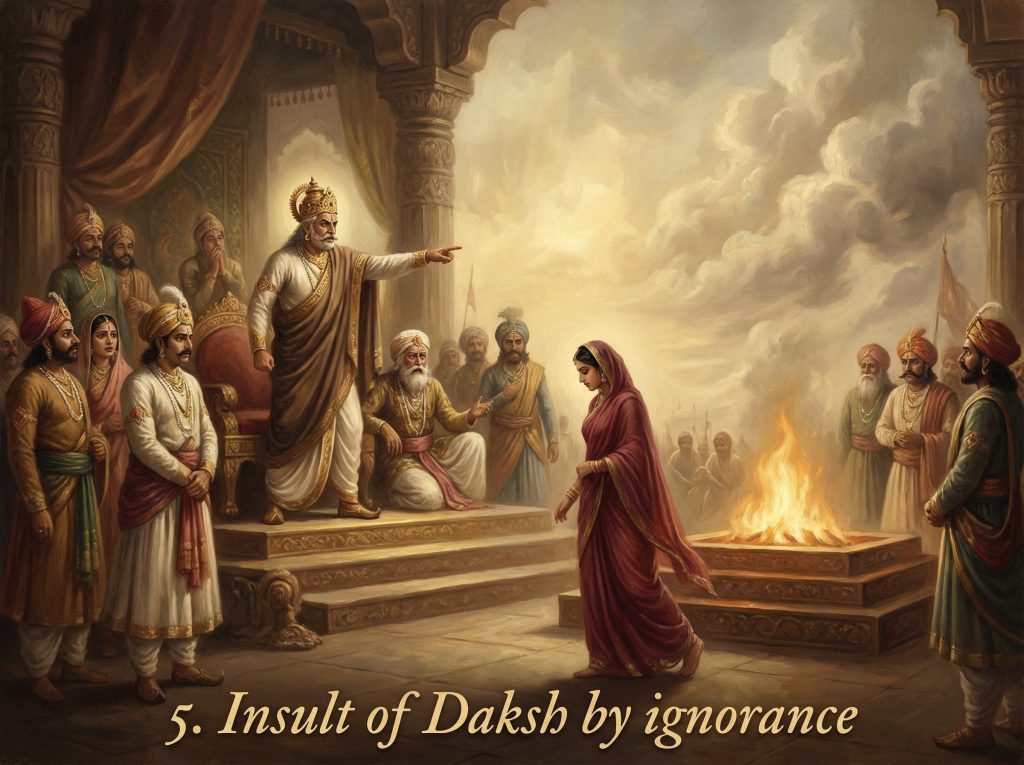
The story of Daksha Yajna shows how ego can destroy everything and how compassionate Bhagwan Shiva truly is. Daksha Prajapati felt insulted when Shiva did not stand up for him during a celestial assembly. Though Shiva’s silence came from detachment, Daksha’s pride was hurt, and he decided to take revenge.
Later, Daksha organised a grand yajna and invited all the gods except Shiva, even instructing them to pass through Mount Kailash, Shiva’s abode. Parvati, Shiva’s wife and Daksha’s daughter, wished to visit her father’s home. Shiva advised her not to go without an invitation, but Parvati insisted and went.
At the yajna, Daksha publicly insulted Shiva. Unable to bear the disrespect toward her husband, Parvati invoked her inner power and entered the sacrificial fire, giving up her life and becoming Sati.
When Shiva learned of her death, his grief turned into fury. He created Veerabhadra, who destroyed the yajna, killed Daksha, and punished those involved. Later, the gods pleaded for forgiveness. Out of compassion, Shiva revived Daksha but replaced his head with a goat’s head, reminding him of the consequences of ego.
The story teaches that pride leads to downfall, while devotion and humility invite divine grace.
💡 Life Lesson
Ego destroys relationships, families, and peace.
Humility invites grace. Pride invites downfall.
True strength lies in detachment, not dominance.
6. The Beauty of the Bare Essentials

We often notice one common feature in almost every portrait of Bhagwan Shiva—he applies ashes on his body and wears a tiger skin, yet he always appears happy, peaceful, and content. He never seems driven by desire or dissatisfaction.
From this way of life, we learn a powerful lesson: simplicity is deeply connected to health, happiness, and productivity. When our needs are few, the mind becomes lighter, more focused, and naturally calm.
In contrast, constantly running after fashion, status, and external appearance may give temporary pleasure, but it rarely brings lasting happiness or true productivity. Bhagwan Shiva reminds us that real joy comes not from accumulation, but from contentment and inner balance.
💡 Life Lesson
Happiness does not come from accumulation.
The more we reduce unnecessary desires, the lighter our mind becomes.
Simplicity increases:
- Productivity
- Emotional clarity
- Health
- Contentment
In a world obsessed with appearance, Shiva teaches authenticity.
7. The ENTIRE family is worshipped

Shiva’s entire family—Parvati, Ganesha, Kartikeya, and Nandi—is worshipped.
Why?
Because they represent ideal household values.
In many scriptures, Shiva shares divine knowledge with Parvati. Their dialogues fill the Puranas with wisdom.
💡 Life Lesson
Spiritual growth should not be isolated.
When families:
- Discuss spiritual topics
- Attend satsang
- Pray together
The home becomes a temple.
Shared spirituality builds unity and peace.
8. Holding Opposites: Mastering Balance in Life
Shiva’s form is full of powerful contrasts:
- Fire in his third eye
- Water (Ganga) flowing from his hair
- Poison in his throat
- Crescent moon on his head
He embodies destruction and nourishment simultaneously.
💡 Life Lesson
Life is full of opposites:
- Success and failure
- Praise and criticism
- Joy and sorrow
The key is balance.
When we remain calm in extremes, we grow stronger and wiser.
Frequently Asked Questions (FAQs)
1. Why is Lord Shiva called the destroyer?
Because he represents transformation. Destruction in Hindu philosophy means clearing the old to make space for the new.
2. What does Shiva’s third eye symbolize?
It symbolizes wisdom, awareness, and the power to destroy ignorance.
3. Why is Shiva’s throat blue?
Because he held the deadly Halahal poison in his throat during Samudra Manthan.
4. What does Shiva teach about meditation?
He teaches that meditation builds willpower, clarity, and spiritual strength.
5. Why is Shiva considered the ideal householder?
Because he balances ascetic life with family responsibilities perfectly.
6. What is the biggest lesson from Lord Shiva’s life?
Balance—between power and compassion, destruction and protection, simplicity and responsibility.
Conclusion: The Eternal Teacher
Lord Shiva is not merely the destroyer of the universe. He is the ultimate teacher of life.
He teaches us:
- To overcome distractions with wisdom
- To endure hardships with patience
- To avoid ego
- To meditate daily
- To live simply
- To maintain faith
- To balance opposites gracefully
By applying these teachings, we do not escape life—we master it.
That is the true grace of Mahadev.

The Power To Defeat Kali!
Defeat Kali Yuga is a question many people ask: “Until Lord Kalki comes to defeat Kali, what power do ordinary...

Divorce With Onion and Garlic!
Before we start, give a thought to yourself: when does a person decide to divorce their spouse? When they realise...

12 Ways to Flip Any Mood Instantly
In this article, we will learn how to control mood instantly and make our emotions strong and stable in any situation. Many...

Ugadi Pachadi: The Six Flavours of Life
The Beginning of Ugadi Every year, Ugadi arrives like a breath of fresh air. Homes are cleaned, doors are decorated...

He Rejected the Status Quo. He Chose Panch Vartman over Popularity
Living with values is not a burden… It is a superpower Churanta Mondal – Cybersecurity Engineer – Sophos | Proud Alumnus of...

The Authentic Ways to Utilise the Law of Attraction
The Law of Attraction is a fundamental principle stating that “like attracts like.” Positive thoughts and actions attract positive outcomes, while negative...

Conceptions of War: Is it Violence or Welfare?
Righteous war in Hinduism is a complex concept that raises an important question: is war merely an act of violence,...

The Regret Free Life Formula: Simple Truths Most People Realize Too Late
Living a regret free life begins with understanding the deeper purpose of our human existence and preparing for the...

Holi and Holika Dahan: Real Meaning, Story & Significance
Holika Dahan There is a story related to Holika Dahan, which is why we burn the Bonfire. In many videos, you might...

Hanumanji’s Compass: 12 Directions for a Meaningful Life
If we go through the life of Hanumanji, then we can find a lot of inspiration and a lot of...